Quixoticgeek
boosted
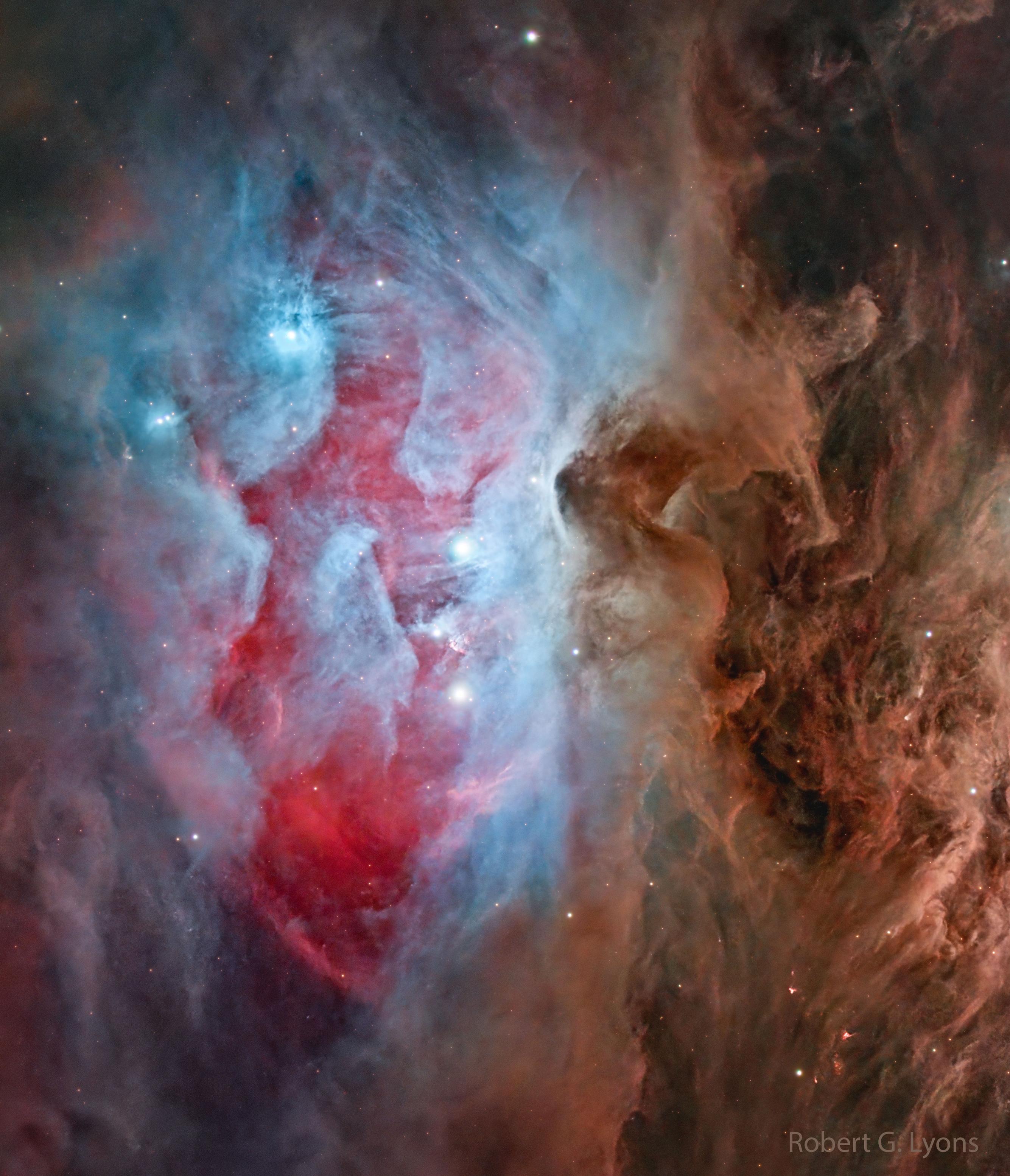
Orion: The Running Man Nebula https://apod.nasa.gov/apod/ap260202.html #APOD
Orion: The Running Man Nebula https://apod.nasa.gov/apod/ap260202.html #APOD
Orion: The Running Man Nebula https://apod.nasa.gov/apod/ap260202.html #APOD
Orion: The Running Man Nebula
Image Credit & Copyright: Robert G. Lyons (Robservatory)
Explanation: What part of Orion is this? Just north of the famous Orion Nebula is a picturesque star forming region in Orion's Sword that contains a lot of intricate dust -- some of which appears blue because it reflects the light of bright embedded stars. The region's popular name is the Running Man Nebula because, looked at from the right, part of the brown dust appears to be running legs. Cataloged as Sharpless 279, the reflection nebula is not only part of the constellation of Orion, but part of the greater Orion molecular cloud complex. Light from the Running Man's bright stars, including 42 Orionis, the bright star closest to the featured image center, is slowly destroying and reshaping the surrounding dust, which will likely be completely gone in about 10 million years. The nebula spans about 15 light years and lies about 1,500 light years away.
Orion: The Running Man Nebula
Image Credit & Copyright: Robert G. Lyons (Robservatory)
Explanation: What part of Orion is this? Just north of the famous Orion Nebula is a picturesque star forming region in Orion's Sword that contains a lot of intricate dust -- some of which appears blue because it reflects the light of bright embedded stars. The region's popular name is the Running Man Nebula because, looked at from the right, part of the brown dust appears to be running legs. Cataloged as Sharpless 279, the reflection nebula is not only part of the constellation of Orion, but part of the greater Orion molecular cloud complex. Light from the Running Man's bright stars, including 42 Orionis, the bright star closest to the featured image center, is slowly destroying and reshaping the surrounding dust, which will likely be completely gone in about 10 million years. The nebula spans about 15 light years and lies about 1,500 light years away.
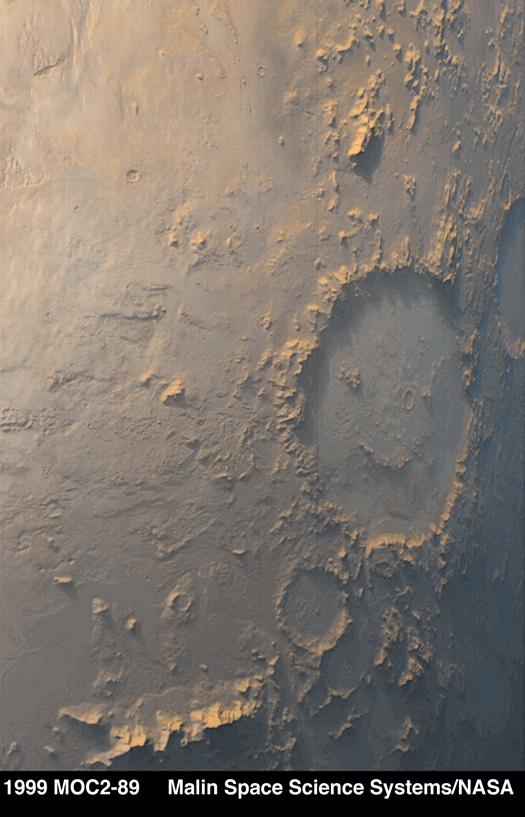
Galle: Happy Face Crater on Mars https://apod.nasa.gov/apod/ap260201.html #APOD
Galle: Happy Face Crater on Mars https://apod.nasa.gov/apod/ap260201.html #APOD
Orion's Treasures over Snowy Mountains
Image Credit & Copyright: Włodzimierz Bubak; Text: Ogetay Kayali (MTU)
Explanation: Rising over a frozen valley in the Tatra Mountains, the familiar stars and nebulas of Orion dominate this wide-field nightscape. The featured deep photo was taken in southern Poland's highest mountain range last month, where dark skies and alpine terrain combined to reveal both Earth's rugged beauty and the structure of our galaxy. Above the snowy mountains, Orion's bright belt stars anchor a region of glowing interstellar clouds. The Great Orion Nebula, a vast stellar nursery visible even to the unaided eye, shines near the center of the scene. Surrounding it is the enormous arc of Barnard's Loop, a faint shell of ionized hydrogen gas spanning much of the constellation. To the left, the round Rosette Nebula glows softly, while the grayish Witch Head Nebula hovers to the right, illuminated by nearby starlight. Near the top, the orange supergiant Betelgeuse marks the hunter's shoulder.
Orion's Treasures over Snowy Mountains
Image Credit & Copyright: Włodzimierz Bubak; Text: Ogetay Kayali (MTU)
Explanation: Rising over a frozen valley in the Tatra Mountains, the familiar stars and nebulas of Orion dominate this wide-field nightscape. The featured deep photo was taken in southern Poland's highest mountain range last month, where dark skies and alpine terrain combined to reveal both Earth's rugged beauty and the structure of our galaxy. Above the snowy mountains, Orion's bright belt stars anchor a region of glowing interstellar clouds. The Great Orion Nebula, a vast stellar nursery visible even to the unaided eye, shines near the center of the scene. Surrounding it is the enormous arc of Barnard's Loop, a faint shell of ionized hydrogen gas spanning much of the constellation. To the left, the round Rosette Nebula glows softly, while the grayish Witch Head Nebula hovers to the right, illuminated by nearby starlight. Near the top, the orange supergiant Betelgeuse marks the hunter's shoulder.
NGC 55: A Galaxy of Nebulas
Image Credit & Copyright: Wolfgang Promper; Text: Ogetay Kayali (MTU)
Explanation: Can you see nebulas in other galaxies? Yes, some nebulas shine brightly enough -- if you know how to look. Clouds of hydrogen and oxygen emit light at very specific colors, and by isolating them, astronomers and astrophotographers can reveal structures that would otherwise be too faint to notice. This deep, 50-hour exposure highlights glowing hydrogen (red) and oxygen (blue) across galaxy NGC 55, viewed nearly edge-on. Also known as the String of Pearls Galaxy, NGC 55 is often compared to our Milky Way's satellite galaxy the Large Magellanic Cloud (LMC), although NGC 55 lies much farther away at about 6.5 million light-years. The resulting image uncovers a sprinkling of emission nebulas within and sometimes above the galaxy's dusty disk, offering a detailed look at distant star-forming regions.
NGC 55: A Galaxy of Nebulas
Image Credit & Copyright: Wolfgang Promper; Text: Ogetay Kayali (MTU)
Explanation: Can you see nebulas in other galaxies? Yes, some nebulas shine brightly enough -- if you know how to look. Clouds of hydrogen and oxygen emit light at very specific colors, and by isolating them, astronomers and astrophotographers can reveal structures that would otherwise be too faint to notice. This deep, 50-hour exposure highlights glowing hydrogen (red) and oxygen (blue) across galaxy NGC 55, viewed nearly edge-on. Also known as the String of Pearls Galaxy, NGC 55 is often compared to our Milky Way's satellite galaxy the Large Magellanic Cloud (LMC), although NGC 55 lies much farther away at about 6.5 million light-years. The resulting image uncovers a sprinkling of emission nebulas within and sometimes above the galaxy's dusty disk, offering a detailed look at distant star-forming regions.
M51: The Whirlpool Galaxy
Image Credit & Copyright: Michael Sleeman
Explanation: The Whirlpool Galaxy is a classic spiral galaxy. At only 30 million light years distant and fully 60 thousand light years across, M51, also known as NGC 5194, is one of the brightest and most picturesque galaxies on the sky. The featured deep image is a digital combination of images taken in different colors over 58 hours with a telescope from Lijiang, China. Anyone with a good pair of binoculars, however, can see this Whirlpool toward the constellation of the Hunting Dogs (Canes Venatici). M51 is a spiral galaxy of type Sc and is the dominant member of a whole group of galaxies. Astronomers speculate that M51's spiral structure is primarily due to its gravitational interaction with the smaller galaxy just above it.
M51: The Whirlpool Galaxy
Image Credit & Copyright: Michael Sleeman
Explanation: The Whirlpool Galaxy is a classic spiral galaxy. At only 30 million light years distant and fully 60 thousand light years across, M51, also known as NGC 5194, is one of the brightest and most picturesque galaxies on the sky. The featured deep image is a digital combination of images taken in different colors over 58 hours with a telescope from Lijiang, China. Anyone with a good pair of binoculars, however, can see this Whirlpool toward the constellation of the Hunting Dogs (Canes Venatici). M51 is a spiral galaxy of type Sc and is the dominant member of a whole group of galaxies. Astronomers speculate that M51's spiral structure is primarily due to its gravitational interaction with the smaller galaxy just above it.
M104: The Sombrero Galaxy in Infrared
This floating ring is the size of a galaxy. In fact, it is a galaxy -- or at least part of one: the photogenic Sombrero Galaxy, one of the largest galaxies in the nearby Virgo Cluster of Galaxies. The dark band of dust that obscures the mid-section of the Sombrero Galaxy in visible light actually glows brightly in infrared light.
Image Credit: NASA, JPL, Caltech, SSC, R. Kennicutt (Steward Obs.) et al.,
M104: The Sombrero Galaxy in Infrared
This floating ring is the size of a galaxy. In fact, it is a galaxy -- or at least part of one: the photogenic Sombrero Galaxy, one of the largest galaxies in the nearby Virgo Cluster of Galaxies. The dark band of dust that obscures the mid-section of the Sombrero Galaxy in visible light actually glows brightly in infrared light.
Image Credit: NASA, JPL, Caltech, SSC, R. Kennicutt (Steward Obs.) et al.,
M104: The Sombrero Galaxy in Infrared
Image Credit: NASA, JPL, Caltech, SSC, R. Kennicutt (Steward Obs.) et al.
Explanation: This floating ring is the size of a galaxy. In fact, it is a galaxy -- or at least part of one: the photogenic Sombrero Galaxy, one of the largest galaxies in the nearby Virgo Cluster of Galaxies. The dark band of dust that obscures the mid-section of the Sombrero Galaxy in visible light actually glows brightly in infrared light. The featured image, digitally sharpened, shows the infrared glow, recently recorded by the orbiting Spitzer Space Telescope, superposed in false-color on an existing image taken by NASA's Hubble Space Telescope in visible light. The Sombrero Galaxy, also known as M104, spans about 50,000 light years and lies 28 million light years away. M104 can be seen with a small telescope in the direction of the constellation Virgo.
M104: The Sombrero Galaxy in Infrared
Image Credit: NASA, JPL, Caltech, SSC, R. Kennicutt (Steward Obs.) et al.
Explanation: This floating ring is the size of a galaxy. In fact, it is a galaxy -- or at least part of one: the photogenic Sombrero Galaxy, one of the largest galaxies in the nearby Virgo Cluster of Galaxies. The dark band of dust that obscures the mid-section of the Sombrero Galaxy in visible light actually glows brightly in infrared light. The featured image, digitally sharpened, shows the infrared glow, recently recorded by the orbiting Spitzer Space Telescope, superposed in false-color on an existing image taken by NASA's Hubble Space Telescope in visible light. The Sombrero Galaxy, also known as M104, spans about 50,000 light years and lies 28 million light years away. M104 can be seen with a small telescope in the direction of the constellation Virgo.
Ice Halos by Moonlight and Sunlight
Image Credit & Copyright: Antonella Cicala
Explanation: Both Moon and Sun create beautiful ice halos in planet Earth's sky. In fact, the two brightest celestial beacons are each surrounded by a complex of ice halos in these photos of the sky above Chamonix-Mont-Blanc in France. The panels were recorded one night (left) and the following day at the end of December 2025. Similar ice halos appear in moonlight and sunlight because they are all formed through the geometry of flat, hexagonal ice crystals. The ice crystals reflect and refract light as they flutter in the cold atmosphere above the mountain resort. In the pictures both Moon and Sun are surrounded by a more commonly seen 22 degree circular halo. Bright and sometimes colorful patches at the intersections of the 22 degree circular halos with the indicated parselenic and parhelic arcs are also known as Moon dogs and Sun dogs.
Ice Halos by Moonlight and Sunlight
Image Credit & Copyright: Antonella Cicala
Explanation: Both Moon and Sun create beautiful ice halos in planet Earth's sky. In fact, the two brightest celestial beacons are each surrounded by a complex of ice halos in these photos of the sky above Chamonix-Mont-Blanc in France. The panels were recorded one night (left) and the following day at the end of December 2025. Similar ice halos appear in moonlight and sunlight because they are all formed through the geometry of flat, hexagonal ice crystals. The ice crystals reflect and refract light as they flutter in the cold atmosphere above the mountain resort. In the pictures both Moon and Sun are surrounded by a more commonly seen 22 degree circular halo. Bright and sometimes colorful patches at the intersections of the 22 degree circular halos with the indicated parselenic and parhelic arcs are also known as Moon dogs and Sun dogs.