

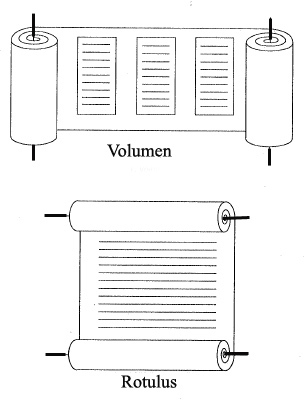
OK, so you've written your book on separate sheets of papyrus, and now you want to glue them together into a scroll. Do you glue the sheets together vertically, so the book is in one very long column, about 20 cm wide? Or do you glue them horizontally, so that the book is a series of short columns, side by side, each one still about 20 cm wide?
Post


@mjd I find it always a bit ironic that nowadays we speak of, say, “volume 1” of a book, but actually refer to a codex (https://en.wikipedia.org/wiki/Codex).
@mrdk Old terminology dies slowly, doesn't it?
Yesterday I was wondering: codices have the index at the back. For a scroll, it seems to me that wouldn't work, you would need to put it at the front where the table of contents is. Was the alphabetic index invented before the scroll was superseded by the codex? And if so, did they put it at the front?
Then again, scrolls are much shorter, so maybe you don[t need a per-scroll index. Instead, I suppose you would have one index scroll, separate from the others, that would tell you which scroll of a multi-volume work had what you were looking for.
@mjd “Was the alphabetic index invented before the scroll was superseded by the codex?” — Not really. Plinius' “Natural History“ has an index and he tells in his preface about another work with an index, but that seem to be the only cases. The problem is that with a scroll, you cannot actually use the index, because “leafing” through the pages (or better, “scrolling”?) would be too much effort.
It is also said that the introduction of Christianity was the reason why in later times, codices were much more popular than scrolls. The problem was the Bible: To work as a theologian, you have jump backward and forward between gospel and prophet books, between different gospels, and so on — much too much work if you have scrolls. The Bible was the first hypertext!
For more about indices, see “Index, A History of the” by David Duncan (https://en.wikipedia.org/wiki/Index,_A_History_of_the).


@mrdk @mjd
Thanks! A great reference on the history and evolution of indices, and its relation to sequential printing technology.
The classical structure and organization of the Talmud might be another early example of a “spatial hypertext”—organized by alternative principles of adjacency and context—to reduce page flipping by the scholar.
https://en.wikipedia.org/wiki/Talmudical_hermeneutics?wprov=sfti1#
#hypertext #history #talmud
Spatial hypertext: https://cs.brown.edu/memex/ACM_HypertextTestbed/papers/37.html