
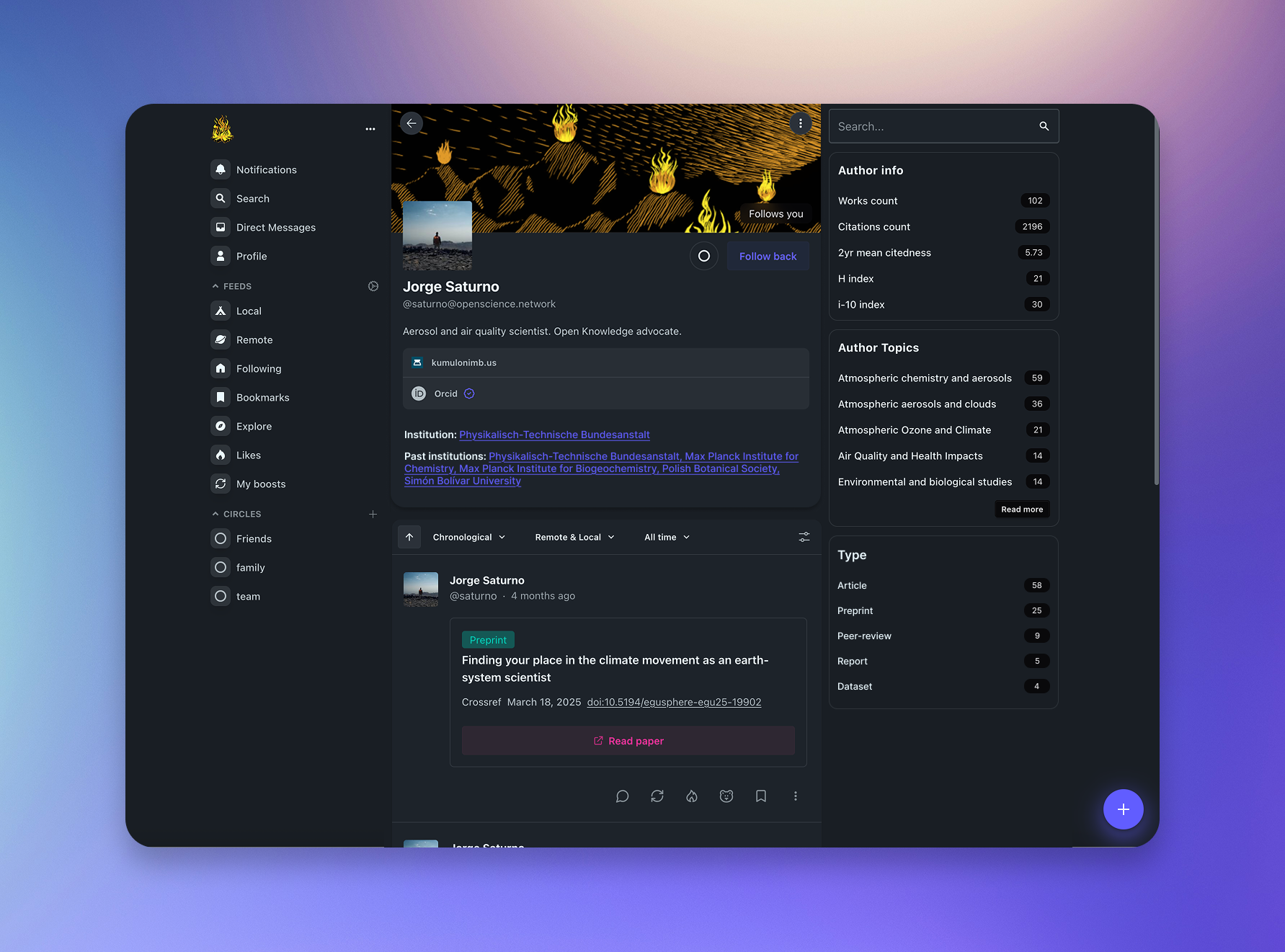
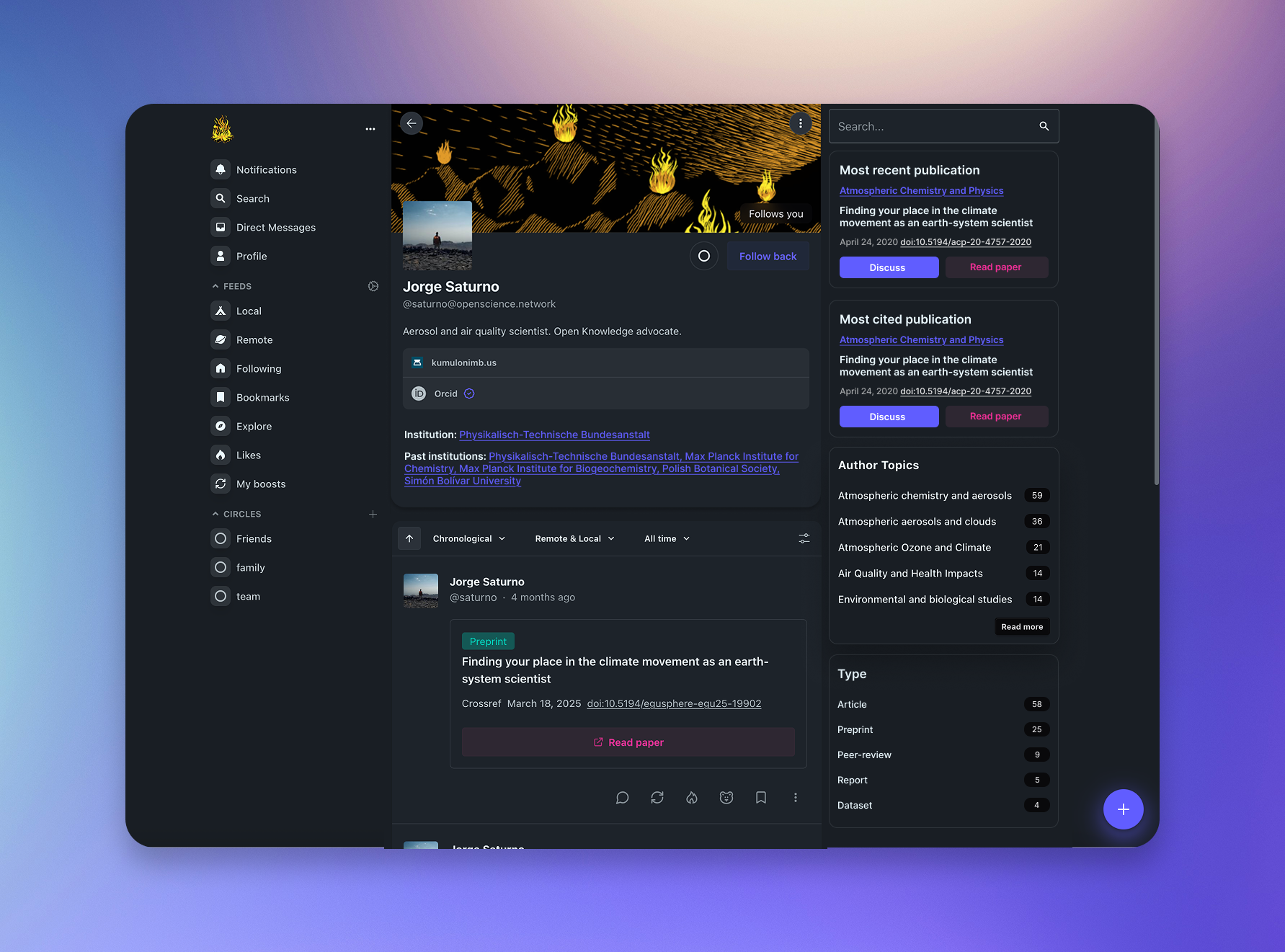
As we integrate #OpenAlex data into the #Bonfire#OpenScience flavor, we're displaying familiar metrics: works count, citations, h-index, research topics, institutional affiliations...
These might be exactly what you need, or perhaps just a starting point.
What additional information would help you find collaborators or understand someone's work better?
We're opening this design process to the open science community. Share what works, what doesn't, what's missing.
@open_science
1/2
Post

@bonfire @open_science oh, just when they happened to reset my profile and now I have 5+ OpenAlex accounts again, and while one has most, it also have stuff of other people :(


@bonfire @open_science Great that you integrate #OpenAlex! I really appreciate your efforts.
However, I am very skeptical about displaying the h-index and i10 index (and probably also about the overall citation count). With #DORA and #CoARA, we want to get away from these indexes. (They are readily available - but that's their deceptive seduction).
To stay in the analogy: At a campfire gathering, I am looking for deep (and also funny and affiliative) conversations with fellow researchers. If there is a guy shouting out his impressive h-index as a greeting, I would immediately leave.
If we try to build a utopian community place, we should not recreate the dysfunctional incentive structures of default academia.
1/
@bonfire @open_science In the German Reproducibility Network @GermanRepro, we developed an academic code of conduct: "Creating a friendly and intellectually stimulating space" (https://reproducibilitynetwork.de/coc/).
This explicitly says: "We discuss views and claims based on the evidence and the quality of arguments, not based on the status of the people making the claim, nor their personal characteristics or their academic rank."
This is the atmosphere I'd like to see at a campfire. Maybe more aspects of that CoC are inspiring for an academic Bonfire.
2/
@bonfire @open_science @GermanRepro What else could be extracted from #OpenAlex?
I would find this helpful:
I would find this helpful:
1. The most recent publication/preprint of a member (as a first author, or also as coauthor?)
2. The most cited publication
3. Affiliation history: Maybe we have a common university in our history?
If your computing resources and the framework allow dyadic information (i.e., how do I relate to every member in the community):
3. What is my coauthor network distance? (I.e., how many hops do you need). If <=3, show the link.
4. What is the publication of that member that is closest to my own works? (e.g., based on embedding dimensions of title and abstract)
That is information that would foster a substantive discourse.
3/3
@nicebread
Here's an updated mockup with widgets for:
- Most recent publication/preprint
- Most cited publication
These are fairly easy to include...
Currently showing only part of the available metadata to avoid overloading the widget, standard previews show more data (e.g., https://openscience.network/discussion/Elixir.Bonfire.Files.Media/01JFTCW4G2Q8RA2NAJJ23VV5YJ#)
We've already included the affiliation history (we call them present/past institutions, shown below the user profile avatar in the mockup...maybe wrong wording?)
@open_science @GermanRepro

@bonfire @nicebread @open_science @GermanRepro I'd argue against most cited as this isn't the best metric to promote. I'd suggest that most recent (preprint or open access) article and then one chosen by the individual. Not everyone would highlight their most cited work but what currently interests them most or what they're proudest of.
@nicebread Awesome! I've just created an issue to keep track of this: https://github.com/bonfire-networks/bonfire-app/issues/1452
For those curious about what's technically possible, here's the OpenAlex API docs: https://docs.openalex.org/
We could explore research networks, collaboration patterns, open access rates, interdisciplinary connections, and more...
The question is:
what would make profiles genuinely useful for how you work?
Let's build this together 🔬
@open_science


@liaizon Kinda sorta, but not really. 😀 @encyclia just consumes the public ORCID API, it doesn't try to channel anything back into ORCID records, nor indeed does it give people any facilities at all for original authorship. It's strictly an ORCID → ActivityPub one-way bridge.
I wrote a bit about the similarities and differences between Encyclia and OSN in the FAQ: https://encyclia.pub/faq#opensciencenetwork OSN's scope has expanded since then, but I think it's still all accurate! 🙂
@liaizon @fresseng @ORCID_Org @open_science yeah we are in touch with @julian and eager to conspire more with @encyclia 🔥


@bonfire @fresseng @ORCID_Org @open_science this is in the same area that @julian is working on with @encyclia if I understand correctly
@fresseng thanks a lot 🙏
we sent a mail to @ORCID_Org to start the procedure, will keep you updated!
@open_science
we sent a mail to @ORCID_Org to start the procedure, will keep you updated!
@open_science

@fresseng is it already possible to migrate an account between mastodon / bonfire instance - and viceversa ( https://github.com/bonfire-networks/bonfire-app/issues/246 )
We have an open issue about migrating also posts and media which requires more thoughts: https://github.com/bonfire-networks/bonfire-app/issues/1304
@open_science
We have an open issue about migrating also posts and media which requires more thoughts: https://github.com/bonfire-networks/bonfire-app/issues/1304
@open_science
@bonfire @fresseng @open_science @wdscholia @RoRInstitute @OpenAlex would be awesome (and make it automatically interoperable with Scholia/Wikidata)
@fresseng @egonw @open_science @wdscholia
wonder if this integration between @RoRInstitute and @OpenAlex can help as well?
https://ror.org/blog/2025-01-27-faster-affiliation-matching/
wonder if this integration between @RoRInstitute and @OpenAlex can help as well?
https://ror.org/blog/2025-01-27-faster-affiliation-matching/