(((Baslow)))
boosted

A Message from the Mayor on Temporary Permanent Status for Haitian New Yorkers
(((Baslow)))
boosted
When we evaluate a new mayor, we are usually taught to separate “style” from “substance,” and to treat visibility, symbolism, and public presence as distractions from the real work of governing. That distinction feels natural—but it is also historically specific, and it may no longer describe how political legitimacy actually forms in a society marked by institutional distrust, media saturation, and social fragmentation.
One way to read the article below is as a familiar early-tenure assessment: is #ZohranMamdani still performing like a candidate, or has he begun governing “for real”? But there is another way to read it—one that does not assume that governing happens only behind closed doors, or that public presence is merely theatrical. From this perspective, visibility, explanation, and embodied action are not substitutes for governance; they are among the conditions that make governance intelligible and credible in the first place.
Mamdani’s early actions—showing up at tenant buildings, explaining the budget directly to the public, appearing in moments of crisis rather than delegating them entirely—can be read not as campaign leftovers, but as an attempt to close the widening gap between political authority and lived experience. In a political culture where institutions often feel distant, opaque, or unresponsive, governing “in public” may be less a performance than a way of rebuilding trust through shared orientation and presence.
The article that follows can still be read critically, and it raises real questions about budgets, appointments, and limits of executive power. But it may also be read as documenting a deeper tension: between an older model of politics that treats legitimacy as something institutions possess and dispense, and an emerging model that treats legitimacy as something that must be continually enacted, explained, and sustained in full view of the people it claims to serve.

When we evaluate a new mayor, we are usually taught to separate “style” from “substance,” and to treat visibility, symbolism, and public presence as distractions from the real work of governing. That distinction feels natural—but it is also historically specific, and it may no longer describe how political legitimacy actually forms in a society marked by institutional distrust, media saturation, and social fragmentation.
One way to read the article below is as a familiar early-tenure assessment: is #ZohranMamdani still performing like a candidate, or has he begun governing “for real”? But there is another way to read it—one that does not assume that governing happens only behind closed doors, or that public presence is merely theatrical. From this perspective, visibility, explanation, and embodied action are not substitutes for governance; they are among the conditions that make governance intelligible and credible in the first place.
Mamdani’s early actions—showing up at tenant buildings, explaining the budget directly to the public, appearing in moments of crisis rather than delegating them entirely—can be read not as campaign leftovers, but as an attempt to close the widening gap between political authority and lived experience. In a political culture where institutions often feel distant, opaque, or unresponsive, governing “in public” may be less a performance than a way of rebuilding trust through shared orientation and presence.
The article that follows can still be read critically, and it raises real questions about budgets, appointments, and limits of executive power. But it may also be read as documenting a deeper tension: between an older model of politics that treats legitimacy as something institutions possess and dispense, and an emerging model that treats legitimacy as something that must be continually enacted, explained, and sustained in full view of the people it claims to serve.
(((Baslow)))
boosted
Opinion: Millionaires must pay their fair share to ensure NYC’s affordability
By John Liu and Phara Souffrant Forrest
the Fair Share Act, legislation we introduced... would authorize New York City to enact a modest 2% surcharge on incomes over $1 million.
It’s entirely fair and appropriate to ask the highest income earners, who just received a permanent 2.6% tax cut courtesy of President Donald Trump, to help generate the revenue needed to strengthen our economy and not leave working New Yorkers behind. This is, quite literally, a matter of fairness and fiscal responsibility.
As it stands, raising taxes on NYC millionaires must happen at the state level.
Governor Kathy Hochul doesn't want to raise taxes on millionaires. Fair enough. But the state legislature should authorize NYC to do so. #MayorMamdani has given them ample warning.

Opinion: Millionaires must pay their fair share to ensure NYC’s affordability
By John Liu and Phara Souffrant Forrest
the Fair Share Act, legislation we introduced... would authorize New York City to enact a modest 2% surcharge on incomes over $1 million.
It’s entirely fair and appropriate to ask the highest income earners, who just received a permanent 2.6% tax cut courtesy of President Donald Trump, to help generate the revenue needed to strengthen our economy and not leave working New Yorkers behind. This is, quite literally, a matter of fairness and fiscal responsibility.
As it stands, raising taxes on NYC millionaires must happen at the state level.
Governor Kathy Hochul doesn't want to raise taxes on millionaires. Fair enough. But the state legislature should authorize NYC to do so. #MayorMamdani has given them ample warning.
(((Baslow)))
boosted
Democratic Socialism as Public Action
Municipal Politics as Praxis
Over the past year, many of us supported Zohran Mamdani because we believed he represented more than a set of policy positions. He seemed to be pointing toward a different way of doing politics—one grounded in participation, visibility, moral clarity, and a refusal to accept the quiet shrinking of public life as inevitable. Now that he is mayor, the question has necessarily changed. The campaign is over. The work of governing has begun. What does democratic socialism look like in practice, once slogans give way to decisions, institutions, and constraints?
That is why this article is worth reading carefully. Not because it praises Mamdani, and not because it claims everything is going smoothly, but because it treats his first weeks in office as a serious political experiment—one with real stakes, real resistance, and real limits. It asks what it means for socialism to become legible as governance, rather than remaining a posture of opposition or a set of ideals waiting for perfect conditions.
One of the most important themes running through the piece is the distinction between policies that merely deliver benefits and politics that actively reshape how people understand their relationship to government and to one another. There is a difference between public goods that are quietly administered and public goods that are openly claimed, explained, and defended as collective achievements. The article suggests—rightly, I think—that socialism succeeds or fails not only on outcomes, but on whether it makes public power visible, accountable, and shared, rather than hidden behind technocratic language or market logic.
The essay also pushes back against two familiar temptations on the left. One is the belief that compromise automatically equals betrayal. The other is the idea that working through institutions is inherently corrupting. What Mamdani’s early moves illustrate is something more demanding: governing as an ongoing process of judgment, direction, and repair. Not purity, but coherence. Not spectacle, but capacity. Not withdrawal from conflict, but a willingness to name what is at stake and act accordingly.
If you are interested in how socialism might be pursued in a way that is serious about power, administration, and democratic legitimacy—without losing its moral imagination—this article repays attention. It does not offer a blueprint. What it offers instead is a way of seeing what is unfolding, and of asking better questions about what must come next.
#MayorMamdani
#UnderstandMamdani
#ZohranMamdani
#EmbodiedPolitics
#ReinventingSocialism

Democratic Socialism as Public Action
Municipal Politics as Praxis
Over the past year, many of us supported Zohran Mamdani because we believed he represented more than a set of policy positions. He seemed to be pointing toward a different way of doing politics—one grounded in participation, visibility, moral clarity, and a refusal to accept the quiet shrinking of public life as inevitable. Now that he is mayor, the question has necessarily changed. The campaign is over. The work of governing has begun. What does democratic socialism look like in practice, once slogans give way to decisions, institutions, and constraints?
That is why this article is worth reading carefully. Not because it praises Mamdani, and not because it claims everything is going smoothly, but because it treats his first weeks in office as a serious political experiment—one with real stakes, real resistance, and real limits. It asks what it means for socialism to become legible as governance, rather than remaining a posture of opposition or a set of ideals waiting for perfect conditions.
One of the most important themes running through the piece is the distinction between policies that merely deliver benefits and politics that actively reshape how people understand their relationship to government and to one another. There is a difference between public goods that are quietly administered and public goods that are openly claimed, explained, and defended as collective achievements. The article suggests—rightly, I think—that socialism succeeds or fails not only on outcomes, but on whether it makes public power visible, accountable, and shared, rather than hidden behind technocratic language or market logic.
The essay also pushes back against two familiar temptations on the left. One is the belief that compromise automatically equals betrayal. The other is the idea that working through institutions is inherently corrupting. What Mamdani’s early moves illustrate is something more demanding: governing as an ongoing process of judgment, direction, and repair. Not purity, but coherence. Not spectacle, but capacity. Not withdrawal from conflict, but a willingness to name what is at stake and act accordingly.
If you are interested in how socialism might be pursued in a way that is serious about power, administration, and democratic legitimacy—without losing its moral imagination—this article repays attention. It does not offer a blueprint. What it offers instead is a way of seeing what is unfolding, and of asking better questions about what must come next.
#MayorMamdani
#UnderstandMamdani
#ZohranMamdani
#EmbodiedPolitics
#ReinventingSocialism
(((Baslow)))
boosted
Mamdani and Sanders Join Picket as N.Y.C. Nurses’ Strike Enters 2nd Week
Here’s what to know about the walkout by about 15,000 New York nurses. On Tuesday, Mayor #ZohranMamdani and Senator Bernie Sanders lent their support.
Mr. Mamdani framed the strike as part of his administration’s focus on affordability. For nurses, the walkout is about making sure “that this is a city you don’t just work in but a city that you can also live in.”
#MayorMamdani
#UnderstandMamdani
https://www.nytimes.com/2026/01/13/nyregion/what-to-know-nyc-nurses-strike.html

Mamdani and Sanders Join Picket as N.Y.C. Nurses’ Strike Enters 2nd Week
Here’s what to know about the walkout by about 15,000 New York nurses. On Tuesday, Mayor #ZohranMamdani and Senator Bernie Sanders lent their support.
Mr. Mamdani framed the strike as part of his administration’s focus on affordability. For nurses, the walkout is about making sure “that this is a city you don’t just work in but a city that you can also live in.”
#MayorMamdani
#UnderstandMamdani
https://www.nytimes.com/2026/01/13/nyregion/what-to-know-nyc-nurses-strike.html
(((Baslow)))
boosted
#ZohranMamdani Has Quickly Gotten Down to Business
If Mamdani succeeds, he will do more than improve working-class New Yorkers’ circumstances. He will lay to rest the axiomatic American belief that efficiency and innovation belong to the private sector and the governments most deferential to it.
#UnderstandMamdani
#MayorMamdani
https://jacobin.com/2026/01/mamdani-executive-orders-housing-childcare
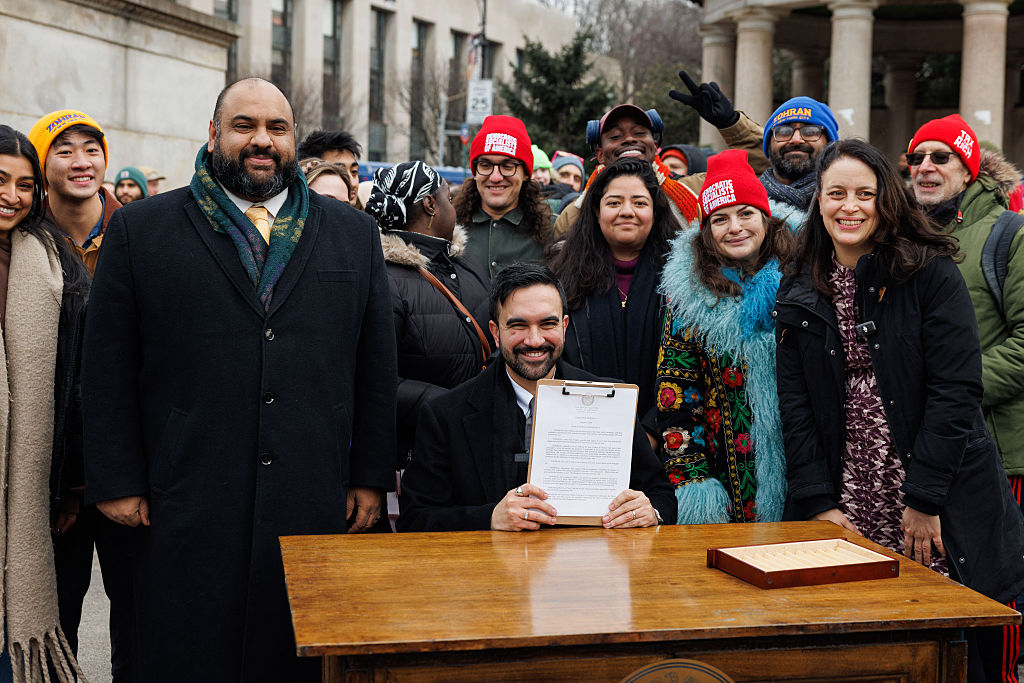
#ZohranMamdani Has Quickly Gotten Down to Business
If Mamdani succeeds, he will do more than improve working-class New Yorkers’ circumstances. He will lay to rest the axiomatic American belief that efficiency and innovation belong to the private sector and the governments most deferential to it.
#UnderstandMamdani
#MayorMamdani
https://jacobin.com/2026/01/mamdani-executive-orders-housing-childcare
(((Baslow)))
boosted
Mamdani’s first 10 days: getting things done despite right’s dystopian fantasies
The New York mayor’s popular moves on rent and free childcare defied rightwing predictions of a far-left hellscape
#ZohranMamdani has eschewed turning the city into the forewarned dystopian nightmare in favor of making progress on campaign promises like housing and rent, while also conducting minor municipal repairs.
#MayorMamdani
#UnderstandMamdani
https://www.theguardian.com/us-news/2026/jan/10/zohran-mamdani-new-york-10-days

Mamdani’s first 10 days: getting things done despite right’s dystopian fantasies
The New York mayor’s popular moves on rent and free childcare defied rightwing predictions of a far-left hellscape
#ZohranMamdani has eschewed turning the city into the forewarned dystopian nightmare in favor of making progress on campaign promises like housing and rent, while also conducting minor municipal repairs.
#MayorMamdani
#UnderstandMamdani
https://www.theguardian.com/us-news/2026/jan/10/zohran-mamdani-new-york-10-days
(((Baslow)))
boosted
'Wheels on the Bus' with Ms. Rachel and Zohran Mamdani in Lower Manhattan
Let's be clear about who is the star attraction in this particular joint appearance -- it's not #ZohranMamdani... but #MayorMamdani seems to know how to share the limelight, and even how to work in a mention of the new childcare initiative he announced with governor Kathy Hochul yesterday.
https://m.youtube.com/watch?v=Cg-NuVg-Fp0&pp=0gcJCTIBo7VqN5tD
'Wheels on the Bus' with Ms. Rachel and Zohran Mamdani in Lower Manhattan
Let's be clear about who is the star attraction in this particular joint appearance -- it's not #ZohranMamdani... but #MayorMamdani seems to know how to share the limelight, and even how to work in a mention of the new childcare initiative he announced with governor Kathy Hochul yesterday.
https://m.youtube.com/watch?v=Cg-NuVg-Fp0&pp=0gcJCTIBo7VqN5tD
(((Baslow)))
boosted
#ZohranMamdani Has More Jewish Support Than You Think
Mamdani, similar to his progressive predecessors, enters office with powerful opposition. Jewish Democrats, split between Mamdani and Cuomo in both the Democratic primary and general election, will remain a crucial bellwether for the mayor, as he embarks on the left’s most ambitious executive project in generations. Once upon a time, the coalition that came together against Mamdani—the ultra-wealthy, pro-Israel forces, ideological moderates, older working-class Democrats, and Republicans—would have easily carried the political day in New York City. Now, as a new day dawns, they have been reduced to a loud minority.

(((Baslow)))
boosted
Governor Hochul Joins the Mamdanissance
The governor backs the mayor on child care
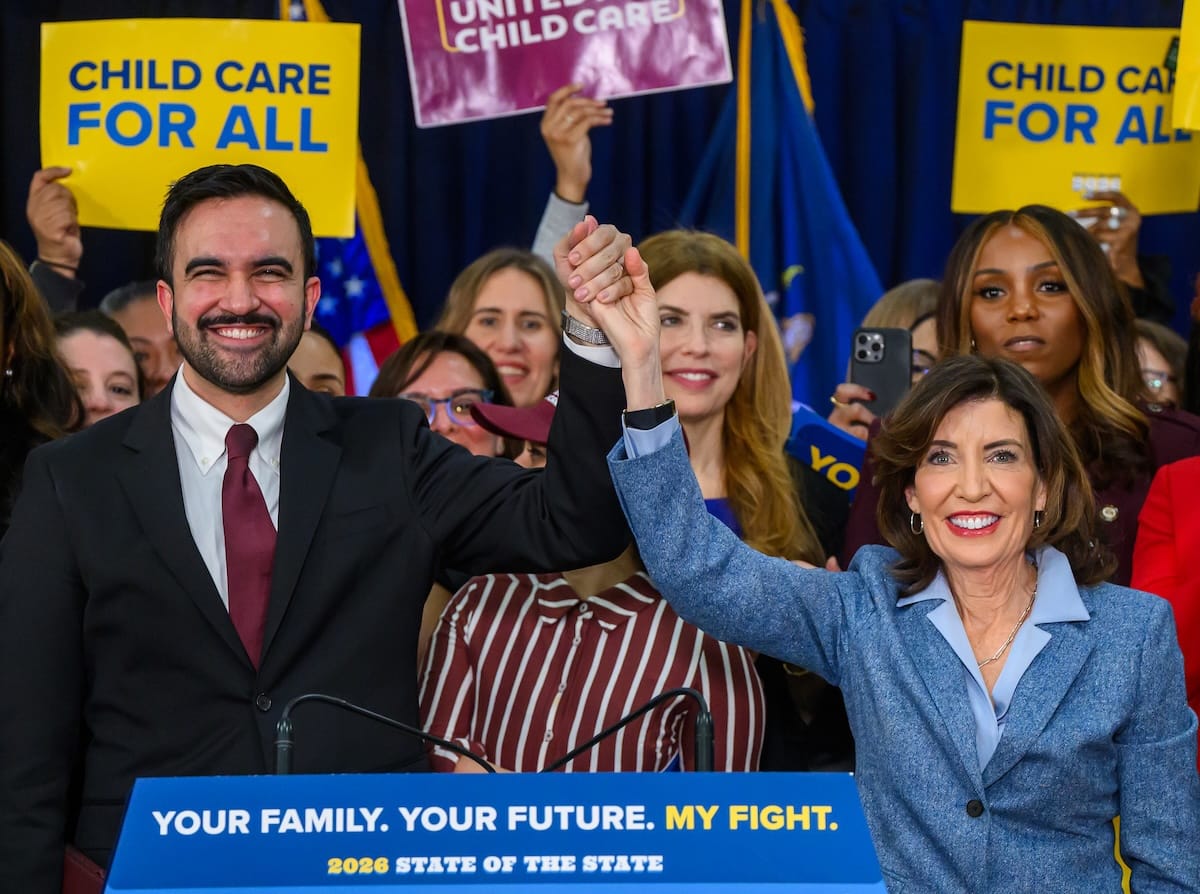
On Thursday afternoon Governor Hochul hitched her political future to Mamdani's, announcing that she was fully embracing the mayor's universal child care program. Phase one: $1.7 billion in proposed new funding, including $500 million for the first two years of Mamdani's plan to provide day care for two-year-olds, another $100 million to patch up 3-K enrollment in New York City, and hundreds of millions more to make universal pre-K a reality across the entire state by 2028, all of which would need to be approved as part of the state's budget process.
"This is the day that everything changes," Hochul told the crowd at the Flatbush YMCA, while standing next to the mayor. "Back in November, fresh off the election, we sat down—we had many conversations leading up to this. But we started talking about how we make this vision become reality, no longer a dream. I told him that whatever the City was ready to deliver, I would be his partner 100 percent of the way."
(((Baslow)))
boosted
RUN ZOHRAN RUN!: Inside #ZohranMamdani’s Sensational Campaign to Become New York City’s First Socialist Mayor
by THEODORE HAMM
OR Books
Grounded in firsthand knowledge of an insurgent campaign, Run Zohran Run! charts the unexpected rise of Zohran Mamdani and his victory in New York City’s 2025 Mayoral Democratic primary.
Mamdani’s straightforward platform—a rent freeze, free buses, universal childcare, and city-run grocery stores—cut through the noise of mainstream politics and resonated with working-class voters struggling in an increasingly unaffordable city.
A 33 year-old immigrant who openly identifies as a democratic socialist, Mamdani drew in Muslim and South Asian voters historically sidelined in city politics. His robust support for Palestinian rights upended traditional politics in New York City, where even the most liberal elected officials refuse to criticize Israel.
The campaign faced relentless institutional resistance—attacks from the New York Times, the New York Post, and vitriol from disgraced former governor Andrew Cuomo and former mayor Michael Bloomberg—but it also demonstrated how Left campaigns can be won.

(((Baslow)))
boosted
#ZohranMamdani’s First New Media Press Conference as Mayor
#MayorMamdani, whose campaign relied so centrally on new media and content creators, holds his first press conference for members of the new media community. He has been answering the questions of mainstream media at sites around New York, where he has been making a flurry of announcements since his inauguration.
This was the first press conference devoted to the media channels by which many of his volunteers and supporters got much of their news about him.